
Glazing and Scumbling
Perspectives from The Artist's Road

Two techniques that can provide depth and luminescence in oil paintings are glazing and scumbling. Examples of both can be seen as far back as the 16th century in the paintings of Titian.
Glazing is typically the application of a thin layer of slightly darker transparent paint over the dry paint on the canvas. The thin, transparent paint allows light rays to pass through it, bouncing off of the lighter surface beneath. Glazing can be used to create a glowing effect and more saturated coloration in a painting. Glazing can be used as a corrective measure to alter an underlying layer of paint, but true glazing is used to create a unique and specific effect and must be carefully applied over a completely dry previous layer. It is a time consuming and painstaking process. It was traditionally used sparingly to highlight only certain parts of a painting.
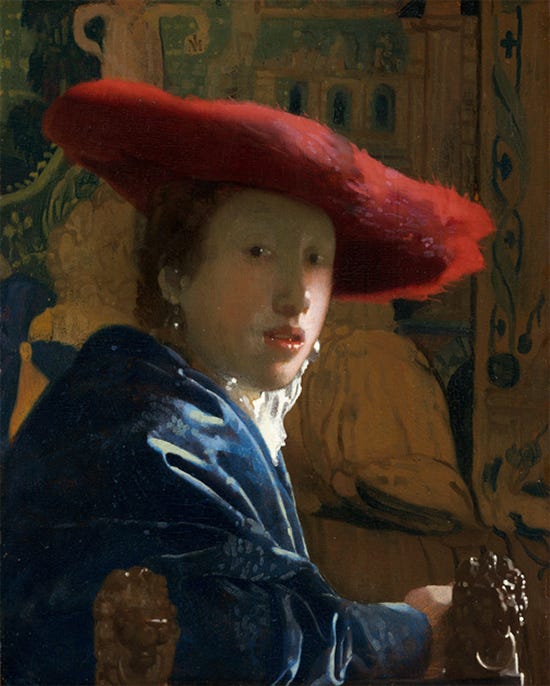
An example often cited is in the painting, Girl with a Red Hat, by Johannes Vermeer, ca. 1665-67.
From: Essential Vermeer:
“The plumed h…