
Night Vision - The Purkinje Effect Revisited
Perspectives from The Artist's Road

The Conversation Oil John Hulsey
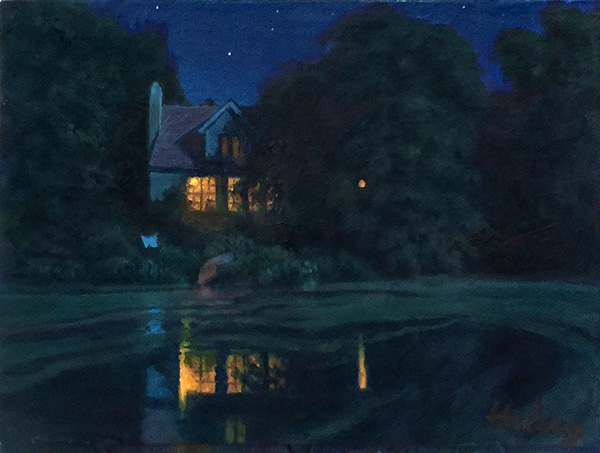
Have you ever noticed how the colors of objects look so radically different in the very low light just before dawn or twilight? Take a red rose, for instance. We know that the flowers are bright red against the green of the leaves in daylight. But, take a look at dusk and you will see that suddenly the contrast is reversed, with the red flower petals now appearing a dark red or dark warm gray, and the leaves appearing relatively bright.
This difference in contrast is called the Purkinje effect, or Purkinje shift, named after the Czech anatomist Jan Evangelista Purkyne who discovered it on his early morning walks in 1819. It is the tendency for the peak luminance sensitivity of the human eye to shift toward the blue end of the spectrum at low illumination levels.
The effect occurs because the color-sensitive cones in the retina are most sensitive to yellow light. The retinal rods are more light-sensitive (good for low lig…