
Of Orange Trees and Waterlilies

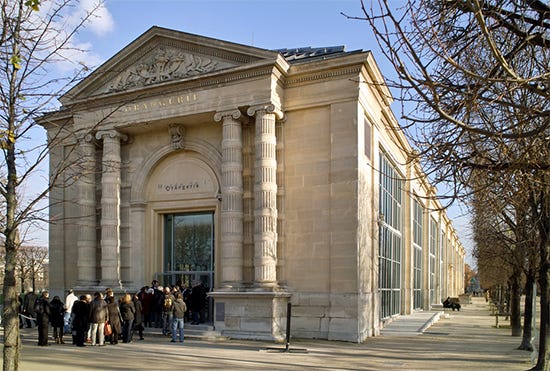
Musée de l’Orangerie (Wikipedia Creative Commons)
The Musée de l’Orangerie was originally built to overwinter the orange trees that lined the garden of the Tuileries Palace in Paris. In 1852, Emperor Napoleon III ordered the building to be designed and constructed along the Seine River, a stone and glass greenhouse structure complete with decorative elements matching those on the Palace itself.
In the early 1870s, after the fire at the Tuileries and the fall of the empire, the orangery became the property of the State, used for various public events, while continuing to provide winter storage for orange trees. But, after World War I, the building was put under the control of the Under-Secretariat of State for Fine Arts. Its new designation was as a space for the exhibition of fine arts by living artists. At the same time, Monet was formalizing his donation of eight large waterlily panels to the State. Together with his friend, the former Prime Minister Georges Clé…