Painting with Glass

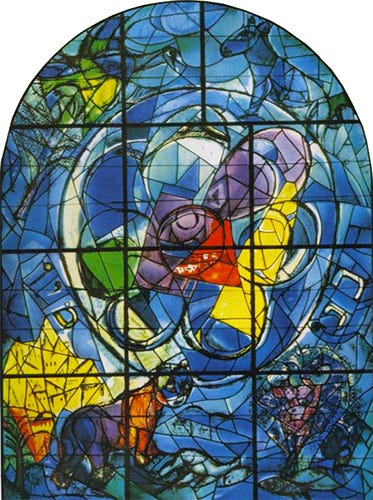
The Tribe of Benjamin, 1962, Marc Chagall
Hadassah Hebrew University Medical Center, Jerusalem (fair use*)
Artists often search for ways to expand their creative expression through experimentation in new mediums. In the case of working with glass, artistry is combined with specialized technical skills and sometimes even complex engineering equations (large stained glass windows, for example) often requiring collaborations with a team of artisans and craftspeople. We were fascinated to discover a small group of post-Impressionist European painters who expanded their artistic oeuvres by making glass artworks and windows.
The art of stained glass has a long ecclesiastical history. Early church windows (dating as far back as the fourth and fifth centuries) were made with thinly sliced alabaster creating translucent light effects. Advances in glass making throughout time have allowed for great ranges of color to become available to artists. Traditionally, stained glass is made by adding metallic salts to the glass during its manufacture. Another technique used is to paint specially formulated colors onto glass directly. The painted colors and glass are then fused together by heat.
Gemmail (from the French for “enamel gem”) is another glass working technique developed in the 1930s. It employs layering hundreds of pieces of colored glass with adhesives onto panels illuminated from behind. The technique was first used by artist Jean Crotti in collaboration with lighting expert and artist, Roger Malherbe-Navarre. Their studio in Paris employed specialists working with artists to recreate their paintings in the new glass medium. The glass layers were put into an enamel-like solution and heated in kilns to fuse them all together. Initially the process was used mainly to reproduce existing paintings. However, young artists began to experiment in the process with their own original compositions when the technique became more well known.
Henri Matisse - 1869-1954
“Creativity takes courage.”
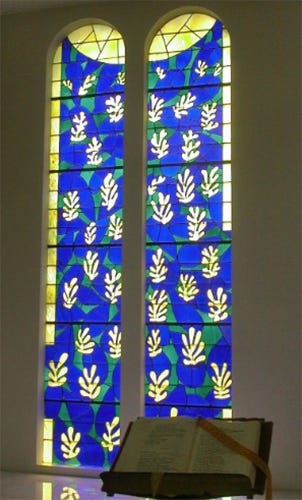
Matisse changed everything. His bright colors and decorative abstracted forms redefined contemporary art at the beginning of the 20th century. He was a prolific artist, much admired by Picasso and others who followed. Late in his life, after serious complications from cancer surgery left him bedridden for several months and then wheel-chair bound, Matisse funneled his creativity into paper cutouts. It seems a natural transition to see his work then progress into stained glass.
Matisse Chapel Stained Glass (Monica Arellano Ongpin via Flickr)