The Beauty Formula
Perspectives from The Artist's Road
In a still very relevant article from The New York Times titled, “Why We Love Beautiful Things”, the late architect and author, Lance Hosey, wrote about research findings and his opinions on the subject. Lance Hosey, former chief sustainability officer at the architecture firm RTKL, was the author of the book “The Shape of Green: Aesthetics, Ecology, and Design.”
The focus of his article is on all the effort and money that is being applied to attempt to quantify and systematize the sort of designs and images which appeal to most people. Studies have found that workers tend to be more productive when they can see the outdoors from their work spaces and that images of landscapes can help to speed patient recovery in hospitals. Hosey writes that findings also show that the visual patterns of fractals in nature at a particular mathematical density can reduce test subjects’ stress levels by as much as 60 percent, simply by being in view. The research is fascinating and seems to show our deeply rooted and strong need for nature. Is beauty archetypal?
Using the principles of beauty to inspire better design is a positive and constructive model. But the notion that art and beauty can be number and factor-crunched into a system seems too simplistic. Art cannot be defined this way, if it can be defined at all.
While the genesis for our need for beauty might be archetypal, the expression of it in any given cultural time period is a moving target and tastes in beauty tend to change. Artists are always the ones who strive to find the beauty of their age and present it to us.
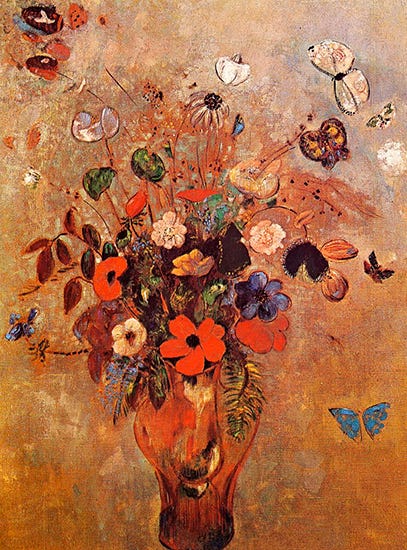
Art comes out of our immensely complex brain functions and radical associations of disparate ideas, some of them subconscious. Few artists can tell you how they arrive at their ideas because inspiration often comes in a flash after a period of intense work. There is a beautiful mystery in this. How do you systematize that? And if one even could, wouldn’t art then lose its beauty, and like the butterfly turning back into a caterpillar, become something much less inspiring?
From The Artist’s Road Store
The Creative Act: A Way of Being - "A work of transcendent literature, one that suggests the universe still smiles upon us despite all indications to the contrary." -The Wall Street Journal