
The Color Organ Revealed
Perspectives from The Artist's Road

Alexander Wallace Rimington’s Color Organ
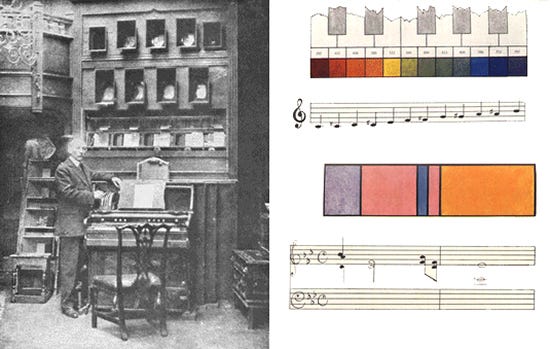
Recently we wrote about synesthesia—the rare neurological condition in which senses are entwined—smells can evoke sounds, music can evoke color, letters or shapes can evoke smell. One of the more common forms of the uncommon condition is called “audition colorée” - the sensing of colors in music and vowels.
Whether or not they suffered from this syndrome, there have been several exceptional creatives throughout history who have worked to combine color and music in the form of machines to create visual music, or “color organs”.
The first known machine was built by a Jesuit Father, Louis Betrand Castel in 1730. His “ocular harpsichord” was comprised of a traditional harpsichord with a six-foot square frame above it containing sixty small windows, each with a different colored glass pane. The aim was to produce visual music. Each time a note was played, a pulley attached to the key would lift a curtain exposing one of t…