
The Impressionists of Indiana
The Hoosier Group

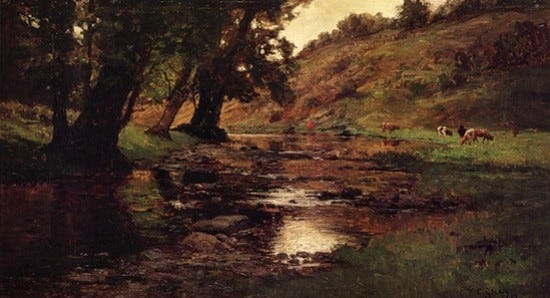
“To live out-of-doors in intimate touch with nature,
to feel the sun, to watch the ever-changing face of the landscape,
where waters run and winds blow and trees wave and clouds move,
and to walk with all the hours of the day and into the mysteries of night
through all the seasons of the year - this is the heaven of the Hoosier Painter!”
- William Forsyth
The names of the five artists of the Hoosier Group of Indiana - Theodore Clement Steele, William Forsyth, Otto Stark, John Ottis Adams and Richard Gruelle - may not be familiar to you, but you may recognize their work. During their time they were a regional artistic force of national significance.
By the time William Merritt Chase was well-established in New York and teaching a new generation of young Americans at the Art Students League (1878-1896) the European techniques he had absorbed, American artists from the Midwest were also leaving their home ground seeking advanced training in painting. Some studied in America with Chase. A few others found the resources to study abroad in Paris, London and notably, at the Munich Academy in Germany, Chase’s old school. While in Europe, they were exposed to the new and radical work of the French Impressionists. Many adopted the style of plein air painting using open brushwork and an emphasis on light, as their own. Most of this generation of talented, highly-trained artists returned to America steeped in old world culture and ready to start their professional careers in the large metropolitan art centers of the United States, where they would find a receptive market and audience for their work. However, a small group of these young artists returned to their home state of Indiana to begin their artistic careers. This is part of what makes them so interesting. In 1894 at an exhibition in the Denison Hotel in Indianapolis organized by four of them (Forsyth, Steele, Stark and Gruelle), they were given the moniker “The Hoosier Group” by Hamlin Garland, a Chicago-based art critic and author. He was so impressed with the quality of their work that he sponsored the same exhibit, with the addition of a fifth artist, Adams, in Chicago the following month, thus helping to kick-start their careers.
“. . . their decision to paint in Indiana, to be regionalists, is even more important in defining the Hoosier Group. These were men who had traveled and studied abroad, who had the talent and opportunity to practice their art anywhere in the Western world. They chose to work in their native Midwest at a time when such writers as James Whitcomb Riley and Carl Sandburg were making the same decision. It was this choice that caught the attention of Hamlin Garland, the most vocal advocate of regionalism in art and literature. The Hoosier Group was part of the movement that gave the Midwest a cultural heritage.”
- Ronald Newlin, “The Best Years: Indiana Paintings of The Hoosier Group, 1880-1915”
Even with the help of Garland’s Chicago exhibition, being part of a regionalist movement in Indiana in 1894 was a tough “row to hoe”. In their early years, most of the Hoosier Group artists had to supplement their living by painting portraits and teaching. Their impressionist landscapes had to be done on the side. Fortunately, Indiana was entering a golden age of prosperity and growth. It was also the era when Indiana gave the nation a president, Benjamin Harrison, and three vice-presidents. Powerful Indiana legislators dominated Congress and still others held cabinet positions and overseas diplomatic posts. All this prosperity and political influence had the effect of creating an affluent class of potential art patrons proud of their state and a generation of prospective art students eager to learn from these renowned masters. With the growth of their reputations over time, many of them were able to abandon portraiture and even teaching to the relative luxury of being full-time painters.