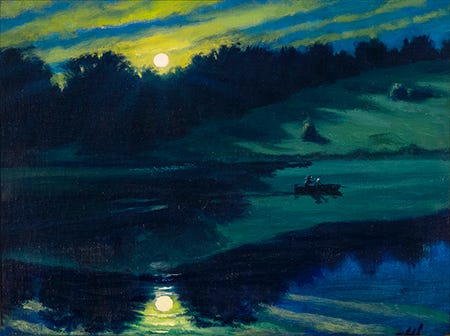
The Science of Nocturne Painting
Perspectives from The Artist's Road
Long-time subscribers of The Artist’s Road know that we are avid practitioners of painting at night. Through our many articles on the subject and in the pages of our book, Nocturnes - A Primer on Night Painting, we have attempted to demystify the techniques needed to paint a successful nocturne and encourage everyone to give it a try. Having a systematic, almost scientific technical approach can really help in this case. There are certain things the aspiring nocturne painter needs to know which will make the process much easier. If you have not read it yet, paid subscribers can follow this link to the article, The Colors of the Night: Mastering the Nocturne or use the search box on the site for Nocturnes to find many related articles on our site. Watercolorists and pastelists will find a number of nocturne demonstrations in watercolor and pastel. Something for everyone.
Perhaps the most frequently asked question we answer is about our palette colors and mixes for nocturne painting. It is a great place to start, and our preferences have developed over years of practice. Below is a color chart which can help you create some useful green mixes for Nocturne painting which were created for an online class of the subject above. Starting with the colors on the left, we cross-mixed a little of the blues from the right side to obtain these interesting deep gray-greens, gradually increasing the amount of the blues into the yellows. These are suitable for warm-weather painting, when the colors of summer are still around. Winter painting requires a slightly different palette arrangement. You will notice that as one nears the middle of each mix, the colors tend to reach a neutral temperature balance, leaning neither toward one side or the other. You will find these very useful. Note also that we can get interesting deep greens by mixing black and yellow together, which are perfect for night-time colors. If you are wondering, we intentionally omitted the light colors made from Titanium white in this chart - those simpler mixes generally play a very small role in nocturne work. We hope this information might encourage you to go out into the backyard some moon-lit night and give it a try. If you do, show us your results. If we get enough of them we might just publish them in an article or blog on The Artist’s Road!