Tonal Impressionism
Perspectives from The Artist's Road

We have been focusing on Tonalism this month, re-reading some inspired books and exploring the subject on canvas with our students in class. One of those books (found used on Amazon) is The Poetic Vision: American Tonalism, published in 2005 by the Spanierman Gallery. The book is a catalog from an exhibition mounted by the gallery. Some of the essays in it delve into the same issue we have been exploring—the intersection of Tonalism and Impressionism.
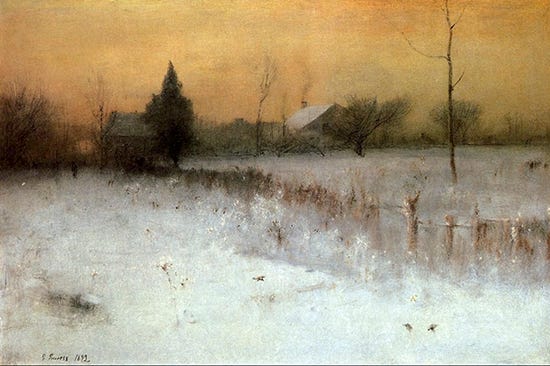
As Tonalism emerged in the late 1800s, it was seen as a more pure and perhaps spiritual art form than Impressionism—an American response to the impressionist paintings initially coming from France. The bright colors and broken strokes of Impressionism had created a firestorm of controversy. To many, the new art style was seen as too scientific, superficial and simply a fad that would soon be gone.
But Tonalism also had French roots—the French Barbizon style which had emphasized mood and atmosphere in paintings. Art critics described the new movement as “Quietism” and “Intimism” in addition to “Tonalism”. The New York Times wrote about an exhibition of Tonalist paintings in 1896 at the Lotos Club in New York, “None of the men here give evidence of sympathy with the present movement of brilliancy of vibrant sunlight, the impressionistic tendencies of pure color effects in high key, or the Monet-like qualities of sparkling pigment, laid on with the full strength of the palette. On the contrary, the men have kept to more quiet efforts in the matter of tone . . . whatever else may be said of the exhibition, it is one of considerable harmony.“
Another reviewer of the exhibition described the difference between the styles of Tonalism and Impressionism as “the presence of sentiment and a melodic rhythm of color, as against mere brushwork in the scientific spirit of the analytic cathode ray.”
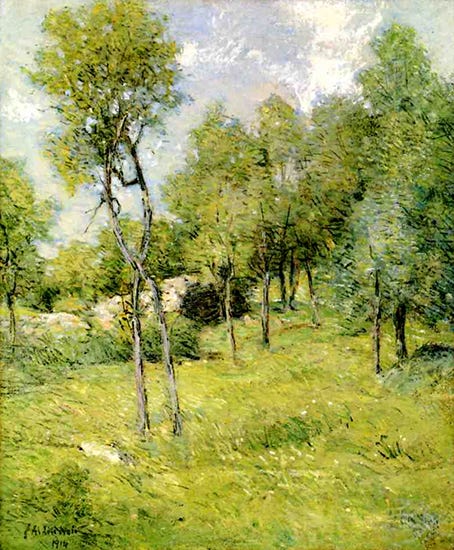
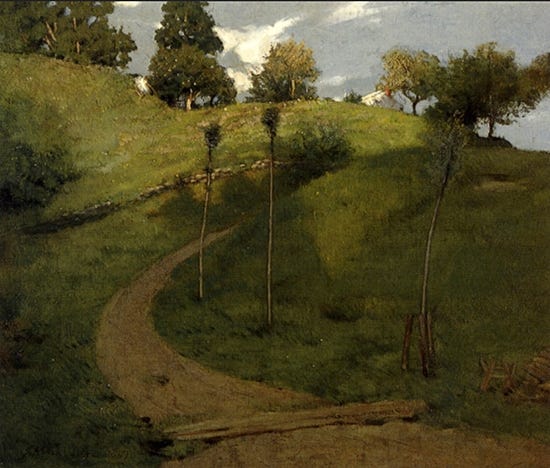
The limited color palette and muted tones of Tonalism were predominant in works by James McNeill Whistler, George Inness, John Twachtman, J. Alden Weir. By the twentieth century, impressionist techniques became more common in some of the Tonalist artists works. Both Twachtman and Weir are now commonly known as Impressionists. Twachtman died at age 49 in 1902. Weir painted another 17 years, dying at age 67 in 1919. It is interesting to look at the progression of Weir’s work as it evolved into what was seen as his unique version of Impressionism combining the muted and sensitive work of Tonalism with the vitality of stroke and color of Impressionism.