
Turner's Gumtion
Perspectives from The Artist's Road

Venice: the Dogana and San Giorgio Maggiore 1834 J.M.W. Turner
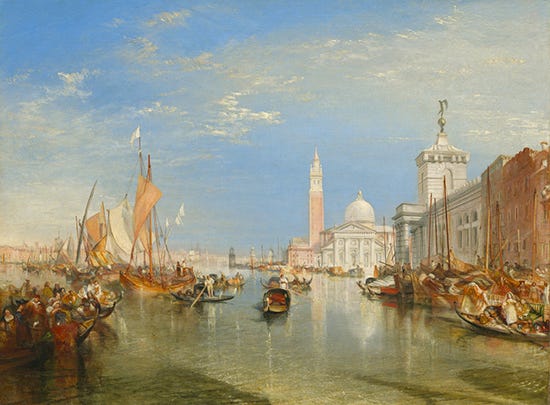
Modern oil paint mediums have come a very long way since the time of J.M.W. Turner (1775 - 1851) and Joshua Reynolds (1723 - 1792). Both of these painters, along with many others, used a medium, mixed with their oil paints, known then variously as Gumtion, McGuilpis, Macgilp and Megilp. No matter what it was called, the formula was essentially a mixture of mastic varnish and an oil such as walnut, linseed, safflower, or poppy oil, cooked with litharge or white lead.
Early oil paints were a combination of oils, pigments and resins and took weeks, if not years, to fully dry. An artist could not add another layer of paint on top of a previous “un-dry” layer without the risk of the paint slowly dripping down the canvas. Turner’s particular formulation of the medium megilp consisted of dried resin from mastic trees, lead acetate, linseed oil and turpentine. The resulting butter-colored, jellylike concoction enabled h…