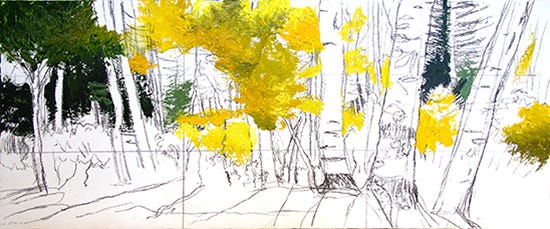
Under the Knife
Using Painting Knives to Create Impressionistic Paintings in Oil


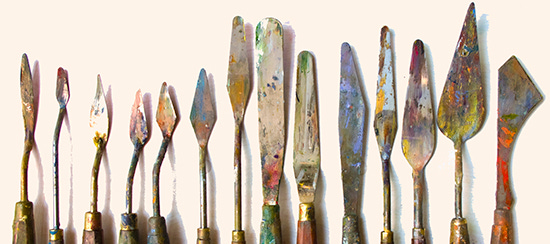
We are always trying different painting tools in an effort to discover new ways of image making. Different tools can help us get out of our comfort zones, where we are divorced from familiar, reliable techniques and perhaps even a little uneasy with the process. This is good! Good art can come from being “in the zone”, or highly focused on what we are doing, but it can also come from a place where the outcome is highly uncertain and we no longer have the accustomed control of our materials. This is the area where the mind can play more freely with ideas, because our expectations of so-called success are different than when we work with our usual reliable techniques. The only way to learn about a new tool is to experiment, play, have fun and see what is possible. If you have never tried painting with knives before and you’d like to shake up your painting style a bit, we hope this article will encourage you to do so.
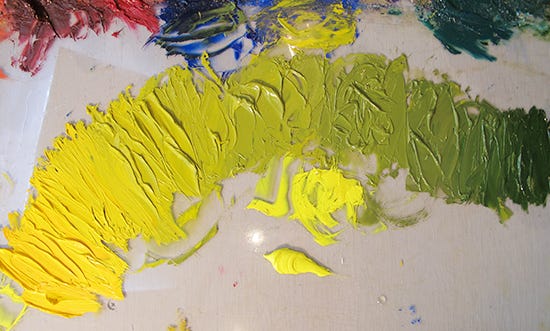
Before I begin painting, I prefer to develop the main mass-tones on my palette by mixing color strings. This is my initial string which covers the first lay-down of cool yellows and greens. Here I have started the string with Cadmium Yellow Medium into Cobalt Blue, then Cadmium Lemon in the center into Cobalt Blue and then Ultramarine for the deepest blue-greens. This string is about 24 inches across.
I will use this palette mix for the entire painting, adding or side-mixing additional warmer or cooler passages from this master string as needed. For example, when I need a very warm orangeish color, I’ll draw paint from my master string off to the side and add Cadmium Orange or maybe a bit of Cadmium Red to create what is needed. In this way, my palette remains harmonized to the original color string and that harmony unites the painting.
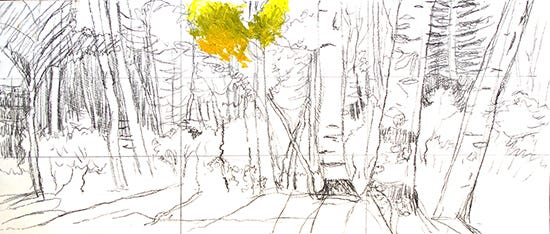
This is my 11.5 x 27.5” masonite panel which I have sealed and triple-primed with gesso. My drawing is fairly precise, having worked out the composition in sketches. I use charcoal or pencil and seal that with a light spray of fixative. My initial paint strokes go down in the center so that I can work out gradually to the ends.