Working Among Flowers
Perspectives from The Artist's Road
“[The floral still life] is, I think, an excellent subject to paint.”
- Claude Monet to Frédéric Bazille
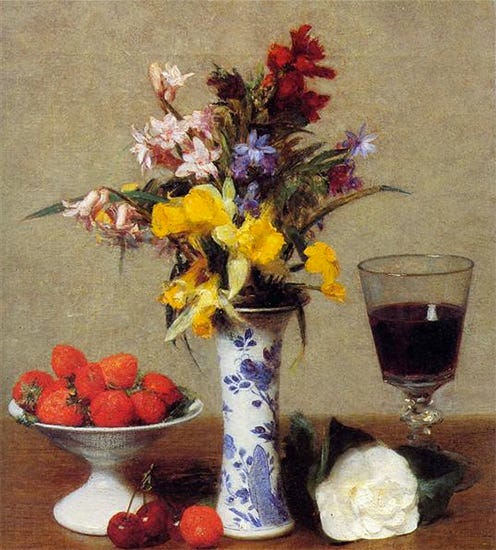
Monet was, of course, exactly right about that. He understood that flowers are among the most difficult subjects to capture—far more demanding than landscapes or a still life without them. The task is similar to portraiture with a heavy dose of artistic interpretation and finesse thrown in. To truly create a floral work of art requires immense skill, experience and intense focus and the best examples of the genre are artistic revelations. Whenever we learn about a major exhibition of still life works by the modern masters, we clear our schedules and pack our bags.
Not long ago, we traveled to see a national traveling exhibition, Working Among Flowers - Floral Still Life Painting in Nineteenth-Century France. Among the many wonderful works in the exhibition were paintings by one of our favorite artists, Henri Fantin-Latour (1836 - 1904). The show included works by dozens of artists including Matisse, Bonnard, Redon, Monet, van Gogh, Cézanne, Cassatt, Renoir as well as earlier works by artists of the eighteenth century including Chardin and Redouté. It traveled from the Dallas Museum of Art to the Virginia Museum of Fine Art, where we had the opportunity to view it, and then on to the Denver Art Museum.
It was comprised of far more than what the title conveys, including works from nearly two centuries, a time during which still life and landscape subjects were beginning to supplant the traditional historical and religious subjects of paintings. The still life was being reinvented and elevated beyond its previous classification of decorative to a new acceptance as important and serious work.
Fantin-Latour was a master of the genre. His exquisite floral still lifes have captivated and inspired us for years and it was a special treat to see this grouping of them in person. But we were not familiar with the equally brilliant work of his wife, artist Victoria Dubourg Fantin-Latour (1840 - 1926). Although the exhibition included only one of her paintings, it spurred us to learn more about her life and work.
Dubourg was born in Paris. It was at age 26 that she met Fantin-Latour at the Louvre, where they were both copying master paintings as part of their study. After a long engagement, they were married in 1876. The painting above was Fantin-Latour’s gift to Dubourg upon their engagement. Dubourg and Fantin-Latour were central to their circle of friends, Edouard Manet, Berthe Morisot and Edgar Degas. Women artists have always had to struggle to get the same wide and lasting recognition as their male contemporaries - even though the quality of their work is equal to, or even surpasses that of the male artists. As a result, Dubourg’s exemplary work is not nearly as well known today as that of her husband or her male artist contemporaries.
The two worked side by side in adjacent studios, both creating paintings that have been called “domestic interior landscapes”, a term which we think demeans the power and artistic expertise evident in their work. For the time, Dubourg’s professional achievements were impressive, indeed. She exhibited at the Paris Salons of 1894 and 1895 and was a member of the Royal Academy from 1882 through 1896. She received the Legion d’Honneur in 1920. She was an award-winner at the Salons and sold works to the Musée de Luxembourg for their permanent collection.
Dubourg and Fantin-Latour, each in their own right, established successful and independent careers. Dubourg was also an avid gardener, and it is believed that the flowers from her cottage garden were those that were used in her paintings and in those of Fantin-Latour.


